
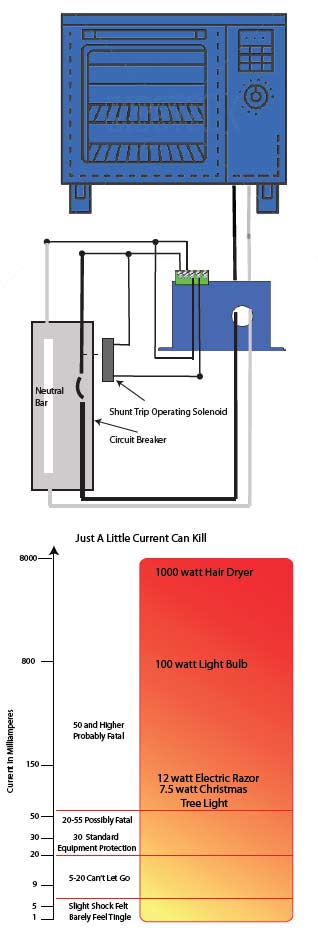
 The NFPA NEC 2017 Sec. 210.8 edition has requirements for ground fault protection of electrically operated commercial kitchen equipment. Specifically, “single-phase receptacles rated 150 volts to ground or less, 50 amperes or less and three-phase receptacles rated 150 volts to ground or less, 100 amperes or less” will have GFCI for personnel protection installed. Prior to this change, only 15 and 20 amps single-phase circuits of 125 volts or less needed this level of protection. Circuit breakers and receptacles with ground fault protection at these levels of power are readily available and quite common. Above 20 amps or three-phase protection is bit more difficult to obtain. There are two ways NK Technologies’ ground fault sensors can help.
If the circuit breaker feeding the equipment can be fitted with a shunt trip operating mechanism, the AG or AGL series sensors with auto reset contacts will detect the fault, and, in turn, will close the circuit to energize the shunt trip solenoid. If the equipment is operated with a magnetic contactor, the sensor used should be the latching output type. The NK Technologies’ sensor contact will be connected to de-energize the contactor coil when a fault is detected.
A major manufacturer of commercial kitchen steamers and grills has reported that their equipment may retain humidity during storage and should be “burned in” or energized for a minimum of two hours with the sensor set at 30 mA. Then, after the equipment has dried out, the sensor trip point can be reset to 5 mA.
NK Technologies offers a tri-set sensor which has this capability. A range jumper is placed at the factory in the highest trip point, 30 mA. By removing this jumper after the equipment has dried, the trip point will be set at 5 mA.
Resetting the trip point to 5mA will cause the circuit with a fault to earth to be disconnected in a very brief period of time, faster than the GFCI outlet in a bathroom works when a fault is detected below 100 mA. A human heart will stop beating when hit with 100 mA or more.
The most important thing to remember is that when a fault to earth occurs, de-energizing the circuit as quickly as possible will keep people working near the equipment as safe from electrocution as possible.
For more information on ground fault sensing, get NK Technologies’ Ground Fault Sensing White Paper.
AG and AGL Ground Fault Sensors
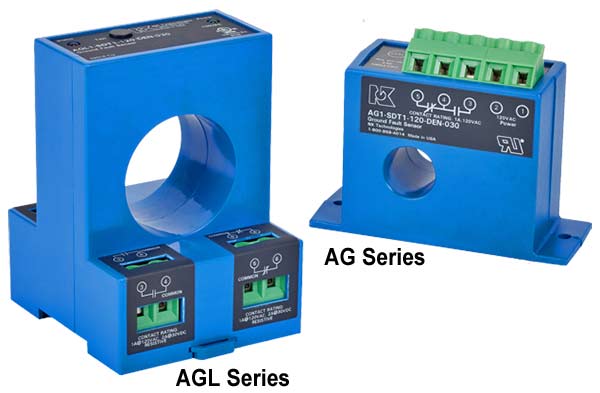 AG ground fault sensors are large enough to monitor 50 amps circuits, while the AGL sensors are large enough to monitor circuits of 300 amps or more. Both products have an extremely fast response time that will improve the safety of the workplace and are more sensitive than a GFCI outlet used in residential applications. The wide temperature range means that these sensors can be installed in very warm or very cold environments. The sensor is completely isolated from the monitored circuit and can be installed quickly on a DIN rail or mounted on a panel using screws.